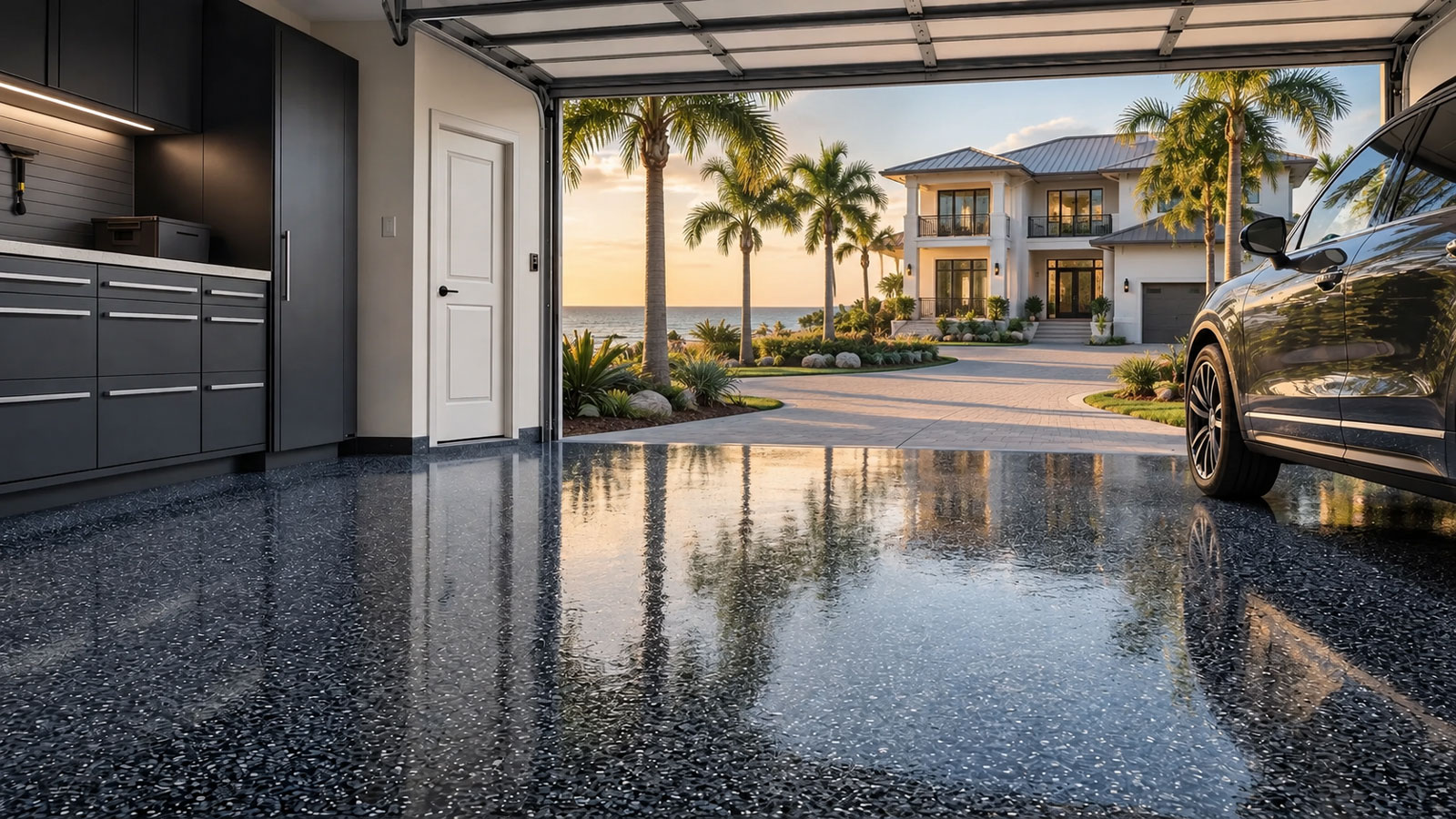
Garage Floor Coating in Daytona Beach, FL
Floor Coating Services in Daytona Beach, FL
Daytona Beach's Adopt-A-Drain program documents a substantial public/private drainage distinction: the city identifies 4,931 city-maintained storm drains and 1,464 privately maintained drains, with discharges toward the Intracoastal Waterway and Tomoka River. Those figures make stormwater stewardship tangible, but they cannot tell a homeowner whether their own garage threshold takes on water, whether an old floor coating is sound, or whether slab moisture is present.
The city's stormwater utility funds flood-prevention projects, drainage maintenance and monitoring; an official September 2025 report describes crews clearing 428 catch basins during a rainy period approaching eight inches in six days. That is evidence of active municipal drainage work, not a universal garage flood diagnosis. For a coating project, inspect the actual concrete, previous paint or sealer, oil staining, cracks, repaired areas and the slope from driveway to garage door.
Daytona's mixed coastal and inland residential settings also bring sun exposure, summer rain and hot tire traffic. A professional coating evaluation should separate water carried in on vehicles from runoff crossing the doorway, and compare the proposed epoxy or polyaspartic layers for UV resistance, traction, proper concrete profiling and realistic return-to-use timing. A decorative surface can aid normal cleaning but cannot replace drainage correction.
Local Market Insight
Daytona Beach lists 4,931 city-maintained and 1,464 privately maintained drains. A September 2025 report described 428 catch basins cleared after nearly eight inches of rain in six days. City infrastructure figures support property-level runoff questions, not claims about every garage slab.
What Affects the Cost of Garage Floor Coating in Daytona Beach?
Daytona Beach operates both city and privately maintained stormwater drains. The number of public drains and recent basin-cleaning work makes runoff a credible local topic, but the estimate needs to respond to the individual driveway, surface and usage rather than a citywide flood label.
Ask for separate prices or defined scope around old finish removal, surface profiling, crack treatment, thresholds, topcoat, texture, cure time and any actual exterior drainage correction.
Daytona Beach-area coating projects use the same core pricing factors: floor size, concrete condition, preparation, system choice, and finish. Planning guidance is $6–$12 per sq ft, with a typical two-car garage commonly in the $3,000–$5,500 range. A professional needs to see the floor before providing a project-specific quote.
- 4,931 city-managed drains: Daytona reports a large public stormwater network, but the existence of a city drain cannot establish whether the garage apron directs water toward the house.
- 1,464 private storm drains: The Adopt-A-Drain program distinguishes privately maintained drains. A property owner should determine the responsible drainage facility and observe actual entry conditions before adding a floor finish.
- 2025 heavy-rain response: The city reported clearing 428 basins during a near-eight-inch rain period. The observation is municipal performance, not proof of dampness beneath every slab.
- Old concrete and previous coatings: Paint, sealers, oil, patch compounds and cracks may require mechanical removal and repair before the system can bond.
- Doorway UV and hot tires: An open garage door can expose the front floor to strong sunlight; compare the specific topcoat's UV rating and parking cure guidance.
- Garage use and edge access: Steps, cabinets, wall details, storage and expected traffic can materially change grinding and finish labor beyond a simple square-foot price.
Call for a clear, project-specific estimate — or request one online.
Daytona Beach's Public and Private Drains: What They Tell a Garage Owner
The City of Daytona Beach's Adopt-A-Drain program makes an important distinction between 4,931 city-maintained storm drains and 1,464 maintained by private owners or associations. Drainage from these facilities can reach the Intracoastal Waterway or Tomoka River. These are concrete infrastructure counts, not tests of a residential garage floor.
The city stormwater utility funds public flood-reduction, treatment and monitoring work. Daytona's September 2025 manager update reports a storm period approaching eight inches of rain over six days, with crews clearing 428 catch basins and significant ditch debris. The response illustrates why drainage maintenance matters at city scale.
For a coating project, the relevant question is narrower: after heavy rain, does water run beneath the garage door or accumulate because of a low apron? Does it appear only where vehicles park? Are prior paint layers peeling? Each observation may affect different work, and none can be inferred from the municipal count of storm drains.
External water-entry problems should be corrected separately from floor preparation. Resin is not a substitute for a blocked private culvert or driveway grade. Ask the contractor to document actual defects, grinding, stable crack repairs, movement-joint treatment and edge scope before discussing decorative systems.
Daytona Rain, Garage Traffic and Finish-Material Decisions
Daytona Beach spans coastal and inland properties with different garage access, sunlight and vehicle use. During the rainy season, water and grit may be tracked inside even where the doorway is correctly graded. That routine surface exposure is separate from water that continuously intrudes from outside.
A previously painted or patched garage slab may require more than ordinary cleaning: old material must be assessed for adhesion, removed if incompatible and mechanically profiled to meet the specified coating manufacturer's preparation standard. Storage cabinets and steps can complicate edge preparation.
A sunlit doorway raises another issue that city drainage data cannot answer. Ask which specific topcoat is UV-stable and how warm tires, parking frequency, finish texture and traction factor into the complete epoxy or polyaspartic assembly. The final coat alone cannot compensate for defective underlying preparation.
Use an itemized estimate to compare material layers, cleaning and repairs, exclusions for exterior drainage, cure conditions and the time vehicles may return. The goal is a usable, cleanable floor on sound concrete, not an unsupported claim that a coating handles every tropical storm.
Frequently Asked Questions
Are Daytona's 4,931 public drains a guarantee my driveway drains well?
No. The Adopt-A-Drain program lists city and private networks, but a particular apron and garage entry need their own review after rain.
What is the significance of 1,464 privately maintained drains?
It means some local drainage facilities are maintained by owners or associations, not the city. Responsibility and actual flow should be checked for the property.
Does the city's 2025 catch-basin cleaning imply every garage is wet?
No. It documents a municipal response to heavy rain. The concrete slab and threshold still require site-level evaluation.
Will an epoxy or polyaspartic coating stop outside water?
No. Persistent runoff beneath the garage door needs exterior correction; a new floor finish can aid ordinary cleanup only after conditions are suitable.
What should a Daytona quote include?
Old-finish removal, grinding, cracks and joints, edges, topcoat UV performance, desired flake or texture and return-to-vehicle timing.
Daytona Beach Neighborhoods & Local Context
Phone Quote Line
Speak with a floor coating specialist about your project and get a realistic estimate range.
(386) 515-7755Typical Project Cost
$3,000–$5,500
Typical planning range for a two-car garage. Final pricing depends on size, concrete condition, preparation, coating type, and finish options.
Helpful Guides