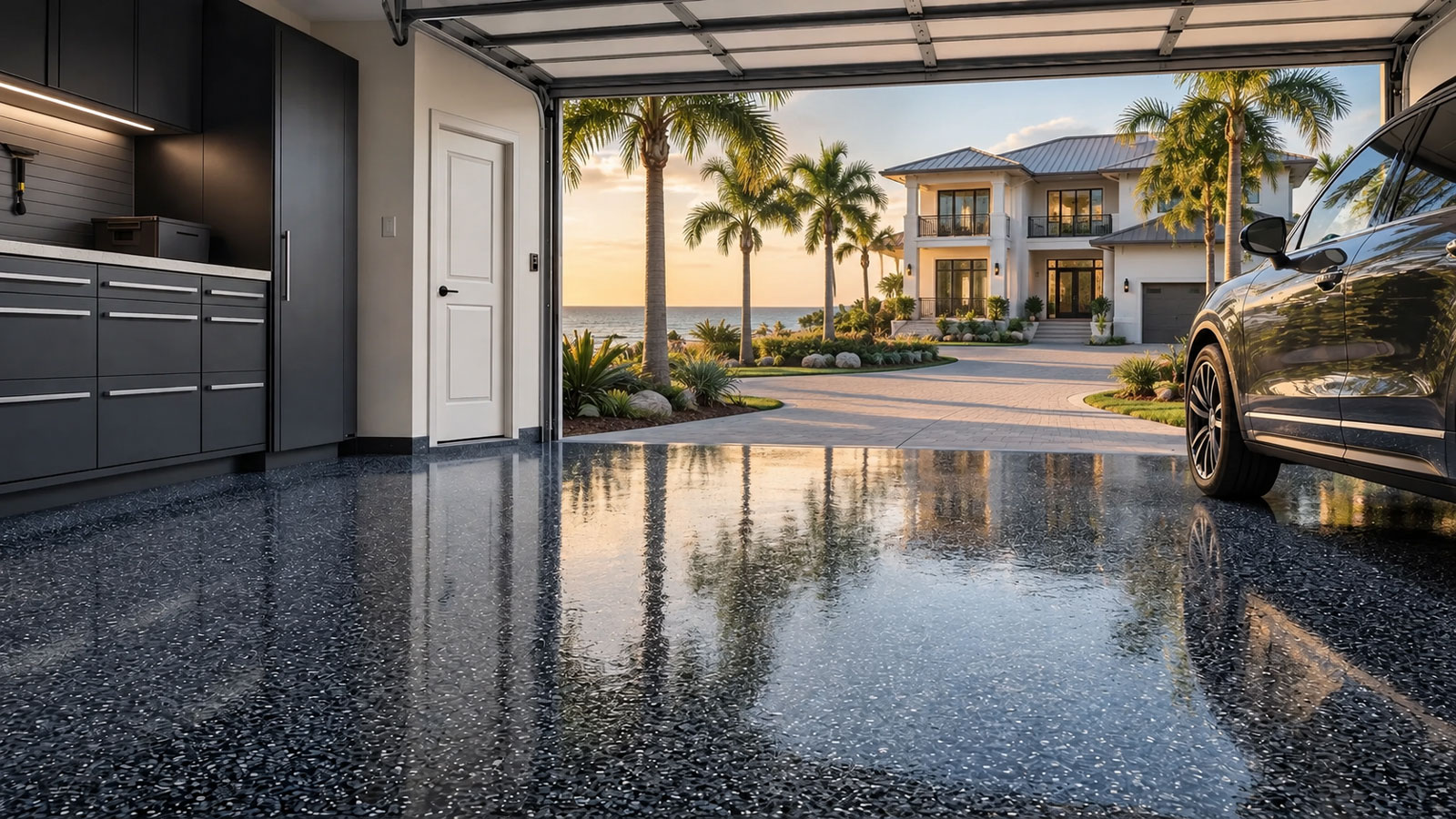
Garage Floor Coating in Edgewater, FL
Floor Coating Services in Edgewater, FL
Edgewater's official stormwater records provide local detail rather than just a generic description of Florida rainfall. Edgewater explains first-flush runoff from paved roads and driveways that carries oil and sediment toward receiving waters. Its stormwater guidance says swales or ponds may take three days to infiltrate after a storm. These municipal facts describe infrastructure and water management at a community scale, however; none tests the adhesion or moisture behavior of a specific residential garage slab. Homeowners should use the information to ask where rainfall travels across their driveway, not to assume every slab needs a barrier.
It recommends contacting the city if standing water persists for a rain-free week. This information adds a second, more practical local consideration. A homeowner should distinguish water tracked in on tires from runoff that repeatedly crosses a low garage-door threshold and from a concrete slab that remains damp after other surfaces dry. The Indian River Lagoon and roadside retention swales in municipal planning are not proof that water is moving through a private floor. Exterior drainage defects deserve separate repairs rather than an extra decorative coating.
For a garage used as parking, storage or a workshop, old floor paint, sealer, oil stains, patch materials and cracked concrete can be bigger coating concerns than broad weather labels. Florida sunlight near an open door also makes UV-stable topcoat selection relevant. Compare actual epoxy or polyaspartic system layers, mechanical surface preparation, moving joints, traction and vehicle-return cure timing. A sound finish can ease ordinary cleaning but cannot prevent a severe storm from entering a garage.
Local Market Insight
City of Edgewater Stormwater Division records that edgewater explains first-flush runoff from paved roads and driveways that carries oil and sediment toward receiving waters. These municipal observations guide questions about a garage's actual apron, old paint, repairs and cure conditions, not blanket claims of concrete moisture.
What Affects the Cost of Garage Floor Coating in Edgewater?
A Edgewater coating bid should be informed by local work around Indian River Lagoon and roadside retention swales, but actual water crossing the door and the condition of the existing slab determine the installation. Its stormwater guidance says swales or ponds may take three days to infiltrate after a storm. These are public drainage matters and cannot replace concrete inspection.
Ask separately for removal of old finishes, profiling, stable crack repairs, moving joint treatment, edges and thresholds, system layers and return-to-vehicle time. An exterior driveway or drainage correction should not be disguised as a garage-coating option.
Daytona Beach-area coating projects use the same core pricing factors: floor size, concrete condition, preparation, system choice, and finish. Planning guidance is $6–$12 per sq ft, with a typical two-car garage commonly in the $3,000–$5,500 range. A professional needs to see the floor before providing a project-specific quote.
- Local water infrastructure: Edgewater explains first-flush runoff from paved roads and driveways that carries oil and sediment toward receiving waters. That evidence is about community stormwater systems, not a moisture test of any individual slab or a reason to sell one universal resin treatment.
- Municipal maintenance and projects: Its stormwater guidance says swales or ponds may take three days to infiltrate after a storm. A property owner should still inspect the direction of runoff on the private driveway and whether the garage entry remains dry.
- Homeowner drainage responsibilities: It recommends contacting the city if standing water persists for a rain-free week. The appropriate response to actual threshold inflow is a separate site-water investigation; a coating cannot change exterior grades or public drainage infrastructure.
- Previously painted or repaired concrete: Check old sealer, floor paint, oil, patch compounds and cracks. The quote should state removal, mechanical grinding and which joints must remain capable of movement.
- Storage, edges and threshold: Built-in cabinets, steps, door lips and narrow access can change perimeter grinding and detailing beyond the garage's measured square footage.
- UV exposure, traction and cure: Compare the actual topcoat in direct sunlight, finish texture, hot-tire performance and when household foot traffic and parked vehicles can return.
Call for a clear, project-specific estimate — or request one online.
Edgewater's Public Drainage Network and Private Garage Entries
Edgewater explains first-flush runoff from paved roads and driveways that carries oil and sediment toward receiving waters. This is a substantive local fact that differentiates Edgewater from its neighbors, but it does not prove a particular house lies at risk of flooding. Municipal pipes, ponds, swales and maintenance projects deal with public water systems at a much greater scale than a single garage.
Its stormwater guidance says swales or ponds may take three days to infiltrate after a storm. The relationship to a homeowner's garage is a question of observed rainwater movement: does the driveway guide water toward the garage door, does rain collect against the threshold or does the floor become wet only when a vehicle is parked? A shared regional watershed cannot answer those questions on its own.
It recommends contacting the city if standing water persists for a rain-free week. If water repeatedly enters from outside, a decorative resin coating cannot substitute for grading, doors, culverts, or drainage repairs. Where a floor merely needs cleaning of ordinary tracked-in grit, the coating project can focus on substrate soundness instead.
Inspect for paint, sealers, oil, weak patches, previous delamination and cracks, and ask which need removal or repair. These findings should be separated in the estimate from any drainage recommendation so local infrastructure context does not turn into an unsupported moisture claim.
Concrete Preparation and Wet-Season Garage Use in Edgewater
Edgewater garages may serve vehicles, storage and household projects under frequent warm-season rain and substantial doorway sunlight. That combination makes actual flooring conditions more important than a generic promise that epoxy or polyaspartic is always better. A decorative finish requires a sound surface and the manufacturer's prescribed mechanical profile.
Conditions around Indian River Lagoon and roadside retention swales also raise a cleaning question. Wet vehicles bring grit and debris onto a floor, while repeated water from outside needs correction beyond the finish. A garage-floor resin system cannot cure poor drainage, weak old paint or a structurally moving concrete joint.
Ask the installer about prior coatings, oil contamination, repaired patches, functional control joints, steps, storage clearances and where the grinding equipment can reach near walls and the driveway lip. Some concrete defects can be repaired before coating; others require a different evaluation or an explicit exclusion.
For system choice, check the primer, body and UV-stable topcoat, traction, texture and product-specific application limits. Obtain separate foot-traffic and vehicle-parking cure times. These details affect durability and day-to-day use more directly than the size of a municipal stormwater project.
Frequently Asked Questions
What do Edgewater's stormwater records say about my garage?
Edgewater explains first-flush runoff from paved roads and driveways that carries oil and sediment toward receiving waters. The records concern municipal infrastructure, not an assessment of the floor at a private address. Inspect concrete and actual threshold water before changing the coating scope.
Is the city's drainage work a guarantee that outside water cannot enter my garage?
No. Its stormwater guidance says swales or ponds may take three days to infiltrate after a storm. An individual driveway slope, culvert or door lip can still create a problem; recurring exterior water entry must be addressed separately.
Why is Indian River Lagoon and roadside retention swales relevant to coating preparation?
This local infrastructure context helps prioritize runoff observations and responsible cleaning, but it does not diagnose slab vapor, old paint adhesion or crack movement. Those require property-specific inspection.
Should old floor paint be coated over in Edgewater?
Not without checking compatibility and soundness. The installer should explain removal of unsuitable material, grinding to the correct profile and treatment of stable defects versus moving joints.
What should a Edgewater garage-floor quote itemize?
Actual floor area, old-finish removal, mechanical profile, cracks and joints, garage-door and edge work, named coating layers, UV and traction considerations, and return-to-vehicle timing.
Edgewater Neighborhoods & Local Context
Phone Quote Line
Speak with a floor coating specialist about your project and get a realistic estimate range.
(386) 515-7755Typical Project Cost
$3,000–$5,500
Typical planning range for a two-car garage. Final pricing depends on size, concrete condition, preparation, coating type, and finish options.
Helpful Guides